


Environmental activists said yesterday that a land reclamation project is not suited for the Changhua Coastal Industrial Park (彰濱工業區), as the government’s reports have already shown that groundwater in the area contains high levels of arsenic.
The group made the remarks at a public hearing held yesterday at the legislature in Taipei that aimed to address public concern about the Ministry of Economic Affairs’ plan to use industrial waste, such as basic oxygen furnace (BOF) slag and coal ash as landfill material, which could contaminate the area’s groundwater and negatively affect the health of local residents.
The Taiwan Water Resources Protection Union said a land reclamation project creating 353 hectares of land using BOF slag and coal ash as landfill material passed an Environmental Impact Assessment in 2010.
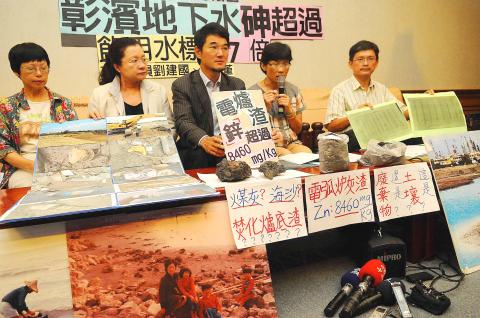
Photo: CNA
However, now with the ministry’s Industrial Development Bureau is proposing another 19.7 hectares of land be reclaimed with BOF slag, the group said it is concerned that heavy metal pollution would spread to nearby wetlands, farms, fish farms and contaminate drinking water.
Democratic Progressive Party Legislator Liu Chien-kuo (劉建國) said the bureau’s own report in 2010 stated that levels of arsenic, considered carcinogenic, in the groundwater were found to exceed drinking water quality standards by as much as seven times.
The report also showed that groundwater near the coast can flow from the industrial park toward the inland areas, so it could contaminate the groundwater in other areas, Liu said.
He said that the majority of residents still rely on groundwater as their main source of drinking water, so the government should stop the land reclamation project.
Several Greater Kaohsiung residents who live near the South Star Plan area said the government has not effectively monitored landfill material deposited in the area in the past 20 years, leading to medical waste being discovered in the area earlier this year and heavy metal contamination being found in ocean sediment.
Chinese Nationalist Party (KMT) Legislator and former Environmental Protection Administration deputy minister Chiu Wen-yen (邱文彥) said he is concerned about the location of the land reclamation, "because unlike Tokyo Bay, which is surrounded by land, Changhua faces the open sea and is hit by stronger waves. If the diffusion effect of seawater is not good enough, the fish farming industry along the coast may be affected."
"We should carefully and comprehensively review this policy, so we don’t end up creating even more problems," he said.


UPGRADE: The Kang Ding-class frigate is replacing its Chaparall missiles with Tien Chien II and Hua Yang VLS, which would provide it with long-range, 360° air defense Taiwan plans to produce 1,200 to 1,376 Hai Chien II missiles (海劍二, Sea Sword II) — also known as TC-2N — to serve as the standard air defense system of the navy’s surface combatant fleet, a source said yesterday. Last week, the Hai Chien II, the naval version of the Tien Kung II missile (天劍二, Sky Sword II), completed a live-fire test in waters off the National Chungshan Institute of Science and Technology’s Jiupeng facility (九鵬) in Pingtung County’s Manjhou Township (滿州). The MIM72 Chaparral and other dated air defense missiles that currently arm Taiwanese ships have inadequate range to combat Chinese

REASONS FOR TRAVEL: An assistant professor said that proposed amendments to penalize drivers if they used drugs overseas would not deter people from traveling People who operate a motor vehicle under the influence of marijuana would have their driver’s license revoked, even if they used the substance while overseas, the Ministry of Transportation and Communications said yesterday, citing proposed amendments to the Road Traffic Management and Penalty Act (道路交通管理處罰條例). The amendments would also authorize the government to revoke the licenses of people determined to have used Category 1 or Category 2 narcotics, even if they were not operating a vehicle while under the influence of drugs, as well as ban them from taking the license test for three years, the ministry said. People aged 18 or
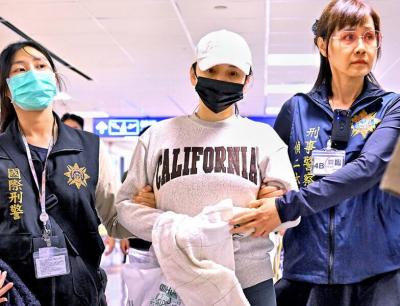
Johanne Liou (劉喬安), a Taiwanese woman who shot to unwanted fame during the Sunflower movement protests in 2014, returned to Taiwan last night after being deported from the US. She is to stand trial in Taiwan for charges involving embezzlement, fraud and drug crimes. The Criminal Investigation Bureau (CIB) said it took her into custody at Taiwan Taoyuan International Airport and would first question her before transferring her to the New Taipei District Prosecutors’ Office. She was arrested upon disembarking a flight from San Francisco that landed shortly before 7pm. Liou absconded to the US in 2019 after jumping bail
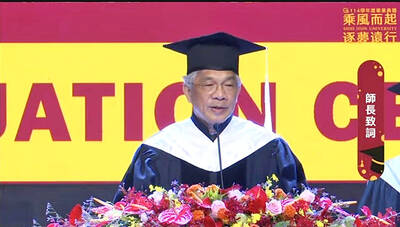
Shih Hsin University President Chen Ching-he (陳清河) yesterday issued a public apology for comments made in his commencement speech last week, stating that he has asked the school to suspend his duties and halt his wages for two months as a show of contrition. At the commencement ceremony on May 30, Chen said, “If you don’t manage your time well, or your own emotions, or your health, then I am telling every one of you — put a quick end to ‘you,’ because the world has no need for ‘you.’” The comments have sparked significant controversy online, and Chen through an open


 RSS
RSS